FOR IMMEDIATE RELEASE
Wednesday, June 24, 2026
Contact:
Rocky Moretti (202) 262-0714
Shelley Hammond (404) 993-3744
Click here for the report, appendices, infographics and news conference recording.
AT 70 YEARS OLD, FLORIDA’S INTERSTATE SYSTEM DELIVERS $3.7 BILLION ANNUALLY IN SAFETY AND MOBILITY BENEFITS, IS EXPERIENCING SIGNIFICANT TRAVEL GROWTH AND IS CONGESTED; REPORT FINDS NEEDED SYSTEM-WIDE RECONSTRUCTION REQUIRES MORE THAN DOUBLING CURRENT FUNDING
Eds: This report’s Appendices includes data for the Interstate System in all states: value of safety and reliability benefits; hours of delays reduced, gallons of fuel saved, travel increase 2000-2024, pavements in poor condition, bridges in poor and fair condition, share of urban Interstates congested, daily travel per urban lane mile, travel by combination trucks, traffic fatality rate on Interstate vs non-Interstate roads and lives saved by Interstate safety features.
Washington, D.C. – As the U.S. celebrates its 250th birthday, the U.S. Interstate Highway System is reaching 70 years old and continues to save lives and reduce delays, providing Americans with $65 billion in benefits annually. But the nation’s most critical transportation network is also congested, carries significant levels of travel – particularly by large trucks – and lacks adequate funding to make needed repairs and improvements. America’s most critical transportation link will need to be rebuilt and expanded to meet the nation’s growing transportation needs, according to a report released today by TRIP, a national transportation research nonprofit. The report, “Saving Lives, Time and Money: Maintaining the Enduring Value of America’s Greatest Infrastructure Achievement, the Interstate Highway System at 70,” looks at the Interstate System’s use, condition and benefits, and the results of findings from the 2019 report prepared by the Transportation Research Board (TRB), at the request of Congress on the condition and use of the Interstate Highway System and actions required to restore and upgrade the Interstate System.
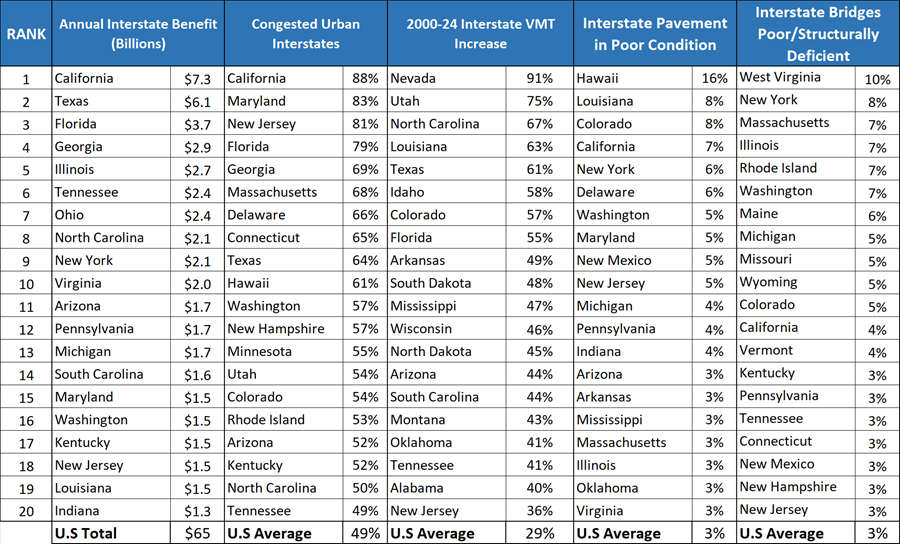
The chart below ranks states whose Interstates are providing the greatest safety and reliability benefits, have greatest share of urban Interstate’s congested, have experienced the greatest increase in vehicle miles of travel (VMT) since 2000, have the largest share of pavement in poor condition, and have the greatest share of bridges in poor condition. Data for all states can be found in the Appendices.
The TRIP report found that the Interstate Highway System is saving Florida residents lives, time and money. Travel on the Interstate Highway System is more than twice as safe as on all other roadways, a result of built-in safety features like median barriers, paved shoulders, a minimum of four lanes, and complete separation from cross traffic and rail lines. The fatality rate per 100 million vehicle miles of travel on Florida’s Interstate highways in 2024 was 0.60, compared to 1.36 on non-Interstate routes. TRIP estimates that additional safety features on Florida’s Interstate Highway System saved 355 lives in 2024.
“The Interstate Highway System remains one of our nation’s most important transportation assets, helping to connect people, goods and services and support safe mobility across the country,” said Jill Ingrassia, Vice President of Public Affairs at AAA, Inc. “As TRIP’s report highlights, continued and increased investment is needed to maintain and modernize the system so it can meet current demands and serve future generations. AAA urges Congress and the administration to work together to ensure the Interstate System remains safe, reliable and efficient for all travelers.”
Based on analysis from the Texas Transportation Institute at Texas A & M University, TRIP estimates that Florida’s Interstate Highway System, which provides improved access and reduces congestion, annually reduces total vehicle delays by approximately 89 million hours and reduces gasoline consumption by 25 million gallons.
TRIP estimates that the annual economic benefit of improved safety on Florida’s Interstate Highway System is $1.25 billion as a result of fewer serious and fatal traffic crashes. The TRIP report also found that Florida’s Interstate highways reduce traffic congestion by providing more efficient and reliable travel, which provides $2.47 billion annually in benefits due to reduced delays and fuel consumption – resulting in a combined benefit to Florida residents of approximately $3.7 billion annually due to improved traffic safety and reduced congestion – the third highest amount among states.
“TRIP’s new report illustrates what’s at stake in the funding debate for the next surface transportation reauthorization bill and will be a valuable tool for policymakers. Our nation’s interstate system is vital for American travel and commerce – to the tune of $65 billion in annual benefits from reduced traffic fatalities and delays,” said John Drake, Vice President, Transportation, Infrastructure, and Supply Chain Policy, U.S. Chamber of Commerce. “Yet, the TRIP report demonstrates that these benefits are at risk unless policymakers provide investments that continue to ensure a safe, modern, and efficient interstate system for the millions of Americans that utilize these corridors every day.”
According to the 2019 TRB report, the Interstate System has a persistent and growing backlog of physical and operational deficiencies as a result of age, heavy use and deferred reinvestment, and is in need of major reconstruction and modernization. The TRB report concludes that annual investment in the Interstate Highway System should be increased approximately two-and-a-half times, from $23 billion in 2018 to $57 billion annually over the next 20 years.
“As we all know, a safe, interconnected, well-maintained, and efficiently operated national transportation network is essential to our nation’s security and economy. The Interstate Highway System plays a pivotal role within that network, moving people and freight alike to their destinations safely,” said Jim Tymon, executive director of the American Association of State Highway and Transportation Officials. “As we look to a federal surface transportation reauthorization, this TRIP report allows us to see just how important it is to invest in our Interstate system and give states the tools they need to ensure safe and efficient transport today and well into the future.”
The TRIP report found that from 2000 to 2024 travel on Florida’s Interstate System increased by 55 percent – the 8th highest rate in the U.S. — and that 79 percent of Florida’s urban Interstate highways are considered congested during peak hours – the 4th highest share among states.
The report also found that travel by combination trucks accounts for nine percent of all travel on Florida’s Interstate highways.
“The TRIP report illustrates just how critical the Interstate Highway System is to moving the nation’s economy,” said Chris Spear, President and CEO of the American Trucking Association. “While Interstates comprise just a small share of the country’s lane-miles, they carry more than half of U.S. large truck traffic. However, a system designed 70 years ago can no longer support the demands of the 21st century. Today, highway congestion costs the trucking industry $109 billion a year, costs that are passed on to American consumers. It is time to renew Eisenhower’s vision for a safe, efficient means of moving long-distance traffic by investing in an Interstate Highway System that meets the needs of the next seven decades and beyond.”
TRIP’s report finds that while pavement smoothness on most segments of the Interstate system is acceptable, the crumbling foundations of most highway segments need to be reconstructed, and that continued resurfacing — rather than addressing underlying foundational issues — is resulting in diminishing returns and results in shorter periods of pavement smoothness.
As the aging system’s foundations continue to deteriorate, most Interstate highways, bridges and interchanges will need to be rebuilt or replaced, the TRB report finds. According to the TRIP report, pavements on four percent of Florida’s Interstate highways are in poor condition. One percent of Florida’s Interstate bridges are rated in poor condition and 34 percent are rated in fair condition.
Restoring and upgrading the Interstate Highway System to meet the nation’s 21st Century transportation needs will require a significant boost in funding, strong federal leadership and a robust federal-state partnership to reestablish the Interstate Highway System as the nation’s premier transportation network. A primary funding source for the Interstate Highway System is the bipartisan Infrastructure Investment and Jobs Act (IIJA), enacted in November 2021. While the IIJA offers a major opportunity to upgrade the safety and reliability of America’s roads, bridges, and transit, its upcoming expiration on September 30, 2026, creates a pressing deadline for reauthorization of the program.
Based on the findings of the TRB Interstate report, TRIP has provided a set of recommendations for the restoration of the Interstate Highway System, which includes: the foundational reconstruction of Interstate highways, bridges and interchanges; improvement to roadway safety features; system right-sizing, including upgrading of some roadway corridors to Interstate standards; adding needed additional highway capacity on existing routes; adding additional corridors; and, modifying some urban segments to maintain connectivity while remediating economic and social disruption.
“The Interstate Highway System at 70 continues to provide tremendous benefits to Americans, saving lives, time and money,” said Dave Kearby, TRIP’s executive director. “It is absolutely vital that we preserve these transportation benefits for future generations of Americans, but this will require that the funding needed to rebuild and modernize our Interstate highways is provided.”