FOR IMMEDIATE RELEASE
Thursday, January 15, 2026 at 10:00 a.m. MST
Contact:
Rocky Moretti (202) 262-0714 (cell)
Carolyn Bonifas Kelly (703) 801-9212 (cell)
Click here for the full report, infographics and news conference recording.
LAS CRUCES MOTORISTS LOSE NEARLY $2,000 PER YEAR ON ROADS THAT ARE ROUGH, CONGESTED & LACK SOME SAFETY FEATURES – $3.3 BILLION STATEWIDE.
$7.5 BILLION IN NEW MEXICO TRANSPORTATION PROJECTS LACK FUNDING TO PROCEED.
Las Cruces, NM – A lack of sufficient transportation funding will make it difficult to adequately maintain and improve New Mexico’s roads and bridges. Increased investment in transportation improvements could improve road, bridge and transit conditions, relieve traffic congestion, boost safety, and support long-term economic growth in New Mexico, according to a new report released today by TRIP, a Washington, DC based national transportation research nonprofit.
New Mexico roads and bridges that are deteriorated, congested, or lack some desirable safety features cost the state’s motorists a total of $3.3 billion annually – $1,985 per driver in the Las Cruces urban area – due to higher vehicle operating costs due to driving on rough roads, congestion-related delays and the financial costs of traffic crashes. The report, entitled “New Mexico Transportation by the Numbers: Meeting the state’s need for safe, smooth and efficient mobility,” includes regional pavement and bridge conditions, highway safety data, and cost breakdowns for the Albuquerque, Las Cruces and Santa Fe urban areas and statewide. A breakdown of the costs per motorist in the state’s largest urban areas, along with a statewide total, is below.

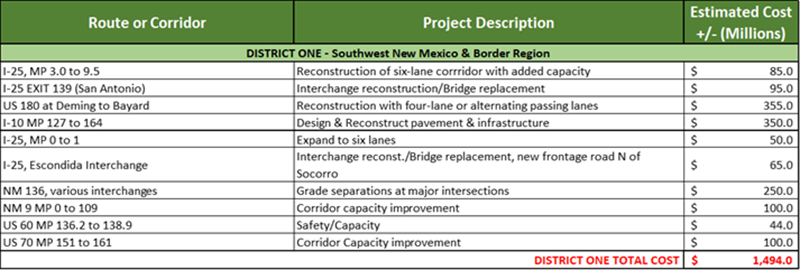
The TRIP report highlights a widening gap between transportation needs and available funding. The New Mexico Department of Transportation (NMDOT) has identified more than $7.5 billion in needed but unfunded transportation projects throughout the state. This funding gap is nearly six times higher than a decade ago in 2017, when NMDOT identified $1.315 billion in needed but unfunded projects. The list below details nearly $1.5 billion in needed projects in southwest New Mexico and the border region. A list of projects statewide is included in the report.
“The stability and future growth of New Mexico’s economy is riding on its surface transportation system,” said New Mexico State Representative Gail Armstrong, minority floor leader and member of the New Mexico House Transportation, Public Works and Capital Improvements Committee. “In order to maintain quality of life and fuel continued economic growth, it is critical that the state provide a safe and modern transportation system that can accommodate future growth in population, tourism, business, recreation and vehicle travel. It is our responsibility and duty as a Legislature to make this happen.”
The TRIP report finds 31 percent of major locally and state-maintained roads in the Las Cruces urban area are in poor condition and another 34 percent are in mediocre condition, costing the average motorist an additional $1,043 each year in extra vehicle operating costs (VOC), including accelerated vehicle depreciation, additional repair costs, and increased fuel consumption and tire wear. Statewide, 34 percent of New Mexico’s major roads are in poor condition and 22 percent are in mediocre condition.
Traffic congestion in the Las Cruces urban area results in the average driver losing 30 hours annually in traffic delays and wasting six gallons of fuel, costing the average Las Cruces driver $482 annually in lost time and wasted fuel. Statewide, New Mexico drivers lose $900 million annually as a result of lost time and wasted fuel due to traffic congestion. Due to the Covid-19 pandemic, vehicle travel in New Mexico dropped by as much as 41 percent in April 2020 (as compared to vehicle travel during the same month the previous year). By 2024, vehicle miles of travel in New Mexico had rebounded to one-percent higher than pre-pandemic levels in 2019.
“Safe and robust transportation infrastructure is one of the most important drivers of economic development,” said New Mexico State Senator George Munoz, chair of the New Mexico State Senate Legislative Finance Committee.
Four percent (172 of 4,033) of New Mexico’s bridges are rated in poor/structurally deficient condition, meaning there is significant deterioration of the bridge deck, supports or other major components. In the Las Cruces area, four percent of bridges are rated in poor/structurally deficient condition. Most bridges are designed to last 50 years before major overhaul or replacement, although many newer bridges are being designed to last 75 years or longer. In New Mexico, 46 percent of the state’s bridges were built in 1969 or earlier. While the state has made significant improvements in bridge conditions since 2002 as a result of increased funding for bridge repair, preservation and maintenance, the condition of bridges is projected to decline over the next decade under current funding projections. The share of National Highway System (NHS) bridges in the state with deck area in poor condition is projected to increase from 3.3 percent in 2002 to six percent in 2031, while the share of deck area in good condition is projected to decline from 34.5 percent to 26.7 percent.
From 2019 to 2024, 2,653 people were killed in traffic crashes in New Mexico. In 2024, New Mexico had 1.56 traffic fatalities for every 100 million miles traveled, significantly higher than the national average of 1.2. Traffic crashes imposed a total of $2.5 billion in economic costs in New Mexico in 2024 and traffic crashes in which a lack of adequate roadway safety features, while not the primary factor, were likely a contributing factor, imposed $839 million in economic costs on the state’s residents. An average of 26 traffic fatalities occurred each year in the Las Cruces area from 2019-2023, resulting in an annual cost per driver of $460 in the economic costs of crashes. Those costs include work and household productivity losses, property damage, medical costs, rehabilitation costs, legal and court costs, congestion costs, and emergency services.
Increasing inflation has hampered New Mexico’s ability to complete needed projects and improvements, as the available funding now covers significantly less work. The Federal Highway Administration’s national highway construction cost index, which measures labor and materials cost, increased by 45 percent from the beginning of 2022 through the first quarter of 2025.
NMDOT projects that by 2050, current State Road Fund revenues will decline 13 percent in nominal terms and 50 percent in inflation adjusted terms as fuel-efficient and electric vehicles reduce gas tax revenues. Over the same period, NMDOT estimates that construction costs will increase 136 percent. The average miles per gallon (MPG) of internal combustion engine vehicles in New Mexico is expected to increase 7.8 percent from FY 2024 to FY 2030. Increases in fuel efficiency are projected to reduce revenue into New Mexico’s State Road Fund by $35.8 million between FY 2024 and FY 2030.
In 2024 New Mexico’s freight system moved 284 million tons of freight, valued at $170 billion. From 2024 to 2050, freight moved annually in New Mexico by trucks is expected to increase 40 percent by weight and 58 percent by value (in inflation-adjusted dollars). This anticipated growth in freight transport in New Mexico, and the rest of the U.S., is a result of further economic growth, changing business and retail models, increasing international trade, and rapidly changing consumer expectations that place an emphasis on faster deliveries, often of smaller packages or payloads.
“The list of needed projects that are not able to move forward will continue to grow longer and conditions will deteriorate further if the state isn’t able to address the significant funding challenges,” said Dave Kearby, TRIP’s executive director. “Without additional investment, New Mexico’s transportation system will become increasingly deteriorated and congested, hampering economic growth, safety and quality of life.”