FOR IMMEDIATE RELEASE
Tuesday, May 19, 2026
Contact:
Rocky Moretti (202) 262-0714 (cell)
Carolyn Bonifas Kelly (703) 801-9212 (cell)
Click here for the full report, infographics and news conference recording.
MONTANA’S TOP TRANSPORTATION CHALLENGES IDENTIFIED IN NEW REPORT; STATE’S TRANSPORTATION SYSTEM FACES GROWING STRAIN FROM INCREASING TRAVEL AND FUNDING PRESSURES
Helena, MT – A lack of sufficient transportation funding will make it difficult to address the state’s top transportation needs and to adequately maintain and improve Montana’s roads and bridges. This is according to a new report released today by TRIP, a Washington, DC based national transportation research nonprofit.
The TRIP report, titled “Keeping Montana Moving Forward: Progress and challenges in achieving a 21st century transportation system in the Big Sky State,” examines road and bridge conditions, traffic safety and funding needs in the state and identifies the top 24 transportation challenges in the state. According to the report, nearly one-third of Montana’s major roads are in poor or mediocre condition, seven percent of the state’s bridges are in poor condition, vehicle travel has grown at one of the fastest rates in the country, and the state’s traffic fatality rate is significantly higher than the national average.
Statewide, a total of 31 percent of Montana’s major roads are in poor or mediocre condition. Driving on rough roads costs the average Montana driver $605 annually in additional vehicle operating costs – a total of $532 million statewide. These additional vehicle operating costs (VOC) include accelerated vehicle depreciation, additional vehicle repair costs, increased fuel consumption and increased tire wear. The chart below details pavement conditions on major roads in the state’s largest urban areas and statewide as well as the extra vehicle operating costs per-driver associated with driving on rough roads.

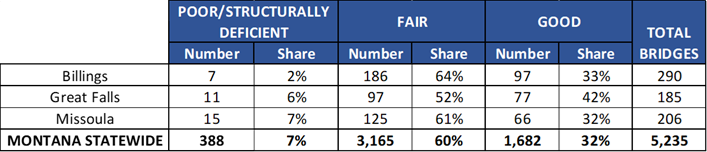
Seven percent (388 of 5,235) of Montana’s bridges are rated in poor/structurally deficient condition. Bridges that are rated poor/structurally deficient have significant deterioration of the bridge deck, supports or other major components. Most bridges are designed to last 50 years before major overhaul or replacement, although many newer bridges are being designed to last 75 years or longer. In Montana, 39 percent of the state’s bridges were built in 1969 or earlier. The chart below details bridge conditions statewide and in the state’s largest urban areas.
“Montanans have consistently done their part to invest in infrastructure, and those investments are paying dividends across the state,” said Allison Corbyn, chief operating officer of the Montana Infrastructure Coalition. “But the reality is our roads, bridges, and water systems are aging, costs are rising, and the gap continues to grow. We have made progress, but there is still more work to do to protect the infrastructure that keeps Montana communities and our economy moving.”
From 2019 to 2024, 1,262 people were killed in traffic crashes in Montana, an average of 210 fatalities each year. The fatality rate on Montana’s non-Interstate rural roads in 2023 was nearly two and a half times higher than all other roads in the state (2.13 per 100 million vehicle miles of travel vs. 0.92). Montana traffic fatalities began to increase dramatically in 2020 and peaked in 2021, even as vehicle travel rates plummeted due to the COVID-19 pandemic. While the number of Montana traffic fatalities has fallen in recent years, it is still significantly higher than in 2019. Despite decreasing each year from 2021 to 2024, the state’s traffic fatality rate per 100 million VMT in 2024 was the seventh highest in the U.S.

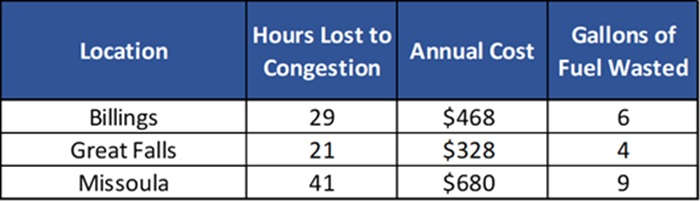
Congested roads, highways and bottlenecks choke commuting and commerce and keep Montana residents and visitors from efficiently getting to their destination. From 2000 to 2024, vehicle travel in Montana increased by 40 percent – the seventh largest increase in the U.S. during that time. While congestion in Montana is largely contained to the state’s largest urban areas and tourist destinations, these areas experience significant delays and decreases in reliability. The chart below details the number of annual hours lost to congestion, cost of lost time and wasted fuel and gallons of fuel wasted per driver in the state’s largest urban areas.
The Montana Department of Transportation (MDT) has identified the state’s top challenges. The following is TRIP’s ranking of Montana’s top 10 transportation challenges.
A summary of the top 10 challenges is listed below, with all 24 projects listed in the report.
- Montana’s Aging Bridges: A Growing Challenge: Across Montana, hundreds of bridges are posted with weight limits, creating major challenges for commercial trucking and agriculture.
- US 191 – Four Corners to MT 64: A corridor study outlined over $350 Million of needed improvements. However, the design options are restricted given the topography along the corridor.
- Statewide Culverts: Many large and small culverts need of replacement due to age and poor condition.
- Interstate 90 – Billings Area: Additional capacity and new interchanges are needed at Lockwood and Johnson Lane.
- Highway 212 Safety and Capacity Improvement: These projects will include passing lanes between Busby and Lame Deer; passing lanes at Ashland Flats; shoulder widening, possibly passing lanes, and pavement preservation work between Broadus and Alzada.
- Interstate 90 – Idaho to St. Regis: Due to age and condition of the pavement, rehabilitation is needed from the Idaho border to St. Regis. Several projects are currently being designed or have recently been constructed along this section of I-90.
- Interstate 90 – Hardin to Wyoming: Due to the age and condition of the pavement, rehabilitation is needed from Hardin to the border with Wyoming. Several pavement preservation projects are designed on this section of I-90. Bridge replacements and deck treatments are needed throughout the corridor.
- Interstate 15 – Great Falls to Sweetgrass: Bridge replacements and deck treatments are needed throughout the corridor, along with improvements to address a lack of interchange capacity and roadway deterioration.
- Interstate 94 – Forsyth to North Dakota: Due to age and condition of the pavement, rehabilitation is needed from Miles City to the border with North Dakota. Bridge replacements and deck treatments are needed throughout the corridor, and several pavement preservation projects are currently being designed.
- Interstate 90 – Bozeman: Capacity improvements are needed to address capacity and performance issues between Three Forks and Rocky Canyon.
“Without additional investment, needed transportation projects in Montana will be left stranded on the drawing board,” said Dave Kearby, TRIP’s executive director. “A well-maintained and well-funded transportation system is essential to keep Montana residents, visitors and businesses moving in a positive direction.”