FOR IMMEDIATE RELEASE
Thursday, December 4, 2025
Contact:
Rocky Moretti (202) 262-0714
Carolyn Bonifas Kelly (703) 801-9212
Click here for the full report, news conference recording and infographics.
TEXANS SAVE $18.1 BILLION PER YEAR AS A RESULT OF ROAD & BRIDGE IMPROVEMENTS MADE WITH ADDITIONAL FUNDING – $2,264 PER HOUSTON HOUSEHOLD- ACCORDING TO NEW REPORT
Passage of Proposition 1 in 2014 and Proposition 7 in 2015 have saved Texans’ lives, time and money.
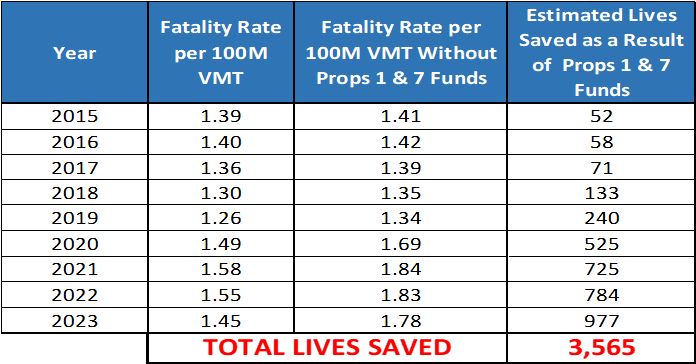
Houston, TX –Texas voters approved Proposition 1 in 2014 and Proposition 7 in 2015, generating nearly $40 billion in additional revenue to Texas’ State Highway Fund and leading to safer, smoother, more efficient travel across the state. Improvements funded by Propositions 1 and 7 have saved Texans a total of $18.1 billion per year – $2,264 per Houston household – and saved 3,565 lives due to improved traffic safety. This is according to a new report by TRIP, a national transportation research nonprofit in Washington, DC.
The TRIP report, “Saving Texans’ Lives, Time and Money: The Impact of Increased Transportation Funding in Providing Texas with a Smoother, Safer, More Reliable Transportation System” examines the benefits to Texas households of the passage of Proposition 1 and Proposition 7. In 2024, these funds made up nearly half ($6.2 billion) of the Texas Department of Transportation’s Unified Transportation Program budget. The additional transportation funding allowed for improved pavement and bridge conditions, reduced congestion and travel times, needed safety improvements, and $18.1 billion in savings for Texans.
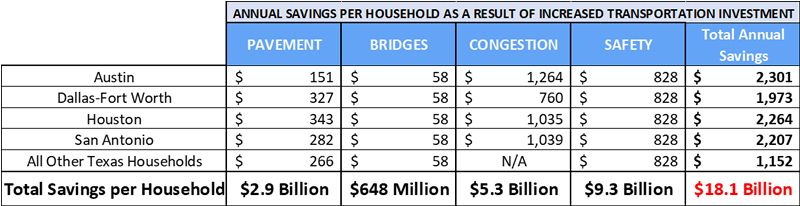
Funding from Proposition 1 and Proposition 7 has supported the Texas Clear Lanes program and other congestion relief projects, mainly in the state’s largest urban areas. These improvements have reduced congestion, improved travel reliability, made travel times more predictable and cut the cost of lost time and wasted fuel. Statewide savings because of decreased congestion total $5.3 billion. The average Houston household currently spends 131 hours annually in traffic congestion. Without the improvements funded by Propositions 1 and 7, the average Houston household would spend 169 hours per year in congestion – a savings of 38 hours per household each year. Currently, rush hour trips in Houston take 27 percent longer to complete than during non-peak times. Without improvements funded by Propositions 1 and 7, trips taken during rush hour would take 43 percent longer than during non-peak travel times.

“The passage of Propositions 1 and 7 continues to deliver transformative benefits for the San Antonio region and statewide” said Victor Boyer, president and CEO of the San Antonio Mobility Coalition. “Beyond the significant cost savings highlighted in the TRIP report, these measures allowed for critical expansions along US 281 North, I-10 East and West, Loop 1604 North, and I-35 on the Northeast Side. These projects had been delayed for up to two decades due to insufficient funding. Today, motorists traveling the newly completed US 281 North and I-10 West corridors are finally experiencing the relief from what was once an unacceptable level of congestion. And within a couple years, drivers along Loop 1604 North and I-35 will realize those same long-awaited benefits.”
Without the additional investments, the current share of state-maintained roads in poor or fair condition would be 16 percent higher. When roads are deteriorated, which may include potholes, rutting or rough surfaces, the cost to operate and maintain a vehicle increases. These additional vehicle operating costs (VOC) include accelerated vehicle depreciation, additional vehicle repair costs, increased fuel consumption, and increased tire wear. Improved pavement conditions as a result of increased transportation funding save the average Houston household $343 each year in vehicle operating costs – a total of $2.9 billion statewide in VOC. The average household statewide saves an average of $266 per year.

“Reliable, safe infrastructure is essential to Houston’s growth and to the look and feel of our city,” said Andrea French, chairwoman of Transportation Advocates of Texas and executive director of Scenic Houston. “These investments make travel safer, strengthen community connections, reduce long-term costs and improve the visual environment across our region. TRIP’s report shows how smart funding improves both mobility and the overall experience of moving through our city.”
The number of state and locally maintained bridges in poor condition decreased by 32 percent from 2015 to 2024 (1,008 bridges to 686). Additionally, 1,824 new bridges have been constructed over the last decade at a cost of approximately $1.9 billion, enhancing mobility and safety. In 2024 the cost to replace all Texas bridges in poor condition was $725 million. TRIP estimates that without additional funding from Proposition 1 & 7 it would cost $986 million in 2024 to replace all Texas bridges in poor condition – a reduction of $263 million. The TRIP report finds that these improvements saved Texans $648 million annually, or $58 per household.
“The foresight by Governor Abbott, Lt Governor Patrick, and the Legislature to invest in Texas’ future by funding significant infrastructure investments in Proposition 1 and Proposition 7 have led to substantial benefits for North Texans,” said Nancy Cline, Dallas Regional Mobility Coalition Board Chair and Carrollton City Council Member.
According to TRIP’s estimates, from 2015 to 2023, roadway safety improvements made possible with revenue generated by Propositions 1 and 7 saved 3,565 lives in Texas. In 2023, traffic crashes in Texas imposed $40.9 billion in economic costs, including work and household productivity losses, property damage, medical costs, rehabilitation costs, legal and court costs, congestion costs, and emergency services. TRIP estimates that without the roadway safety improvements made possible by Proposition 1 and Proposition 7, the annual economic cost of traffic crashes in the state would have been $50.2 billion, saving Texans $9.3 billion dollars – a savings of $828 per household.
“Texas voters made a forward-thinking investment in their state’s future when they approved Propositions 1 and 7,” said Dave Kearby, TRIP’s executive director. “The additional funding has delivered significant returns, saving billions of dollars for families and businesses while making roads safer, smoother and more reliable for everyone.”