FOR IMMEDIATE RELEASE
Thursday, September 24, 2026
Contact:
Rocky Moretti (202) 262-0714 (cell)
Shelley Hammond (404) 993-3744 (cell)
Click here for the full report, infographics and news conference recording.
WISCONSIN MOTORISTS LOSE $9 BILLION PER YEAR DRIVING ON ROADS THAT ARE ROUGH, CONGESTED & LACK SOME DESIRABLE SAFETY FEATURES – OVER $3,400 PER DRIVER IN SOME AREAS; LACK OF ADEQUATE FUNDING COULD DELAY PROJECTS TO RELIEVE AND IMPROVE ROADS AND BRIDGES
Madison, WI – Roads and bridges that are deteriorated, congested or lack some desirable safety features cost Wisconsin motorists a total of $9 billion statewide annually – as much as $3,424 per driver in some areas – due to higher vehicle operating costs, traffic crashes and congestion-related delays. A lack of adequate investment in transportation and increasing inflation in construction costs could hamper Wisconsin’s ability to make needed improvements to its transportation network, according to a new report released today by TRIP, a Washington, DC based national transportation research nonprofit.
The TRIP report, “Wisconsin Transportation By the Numbers: Providing a Modern, Sustainable Transportation System In the Badger State,” finds that throughout Wisconsin, 42 percent of major locally and state-maintained roads are in poor or mediocre condition, six percent of locally and state-maintained bridges (20 feet or more in length) are rated poor in poor condition, increasing vehicle travel is resulting in growing traffic congestion that is choking commuting and commerce, and nearly 600 people are being killed annually in vehicle crashes in the state.
Wisconsin’s population grew to about 6 million residents in 2025, an 11 percent increase since 2000 and the state’s gross domestic product increased by 45 percent from 2000 to 2025, when adjusted for inflation. From 2000 to 2025, annual vehicle miles of travel (VMT) in Wisconsin increased by 20 percent, to approximately 69 billion miles traveled annually. And during the first six months of 2026, VMT in Wisconsin increased three percent from the first six months of 2025.
The TRIP report includes statewide and regional pavement and bridge conditions, congestion data, highway safety data, and cost breakdowns for the Eau Claire, Green Bay-Appleton-Oshkosh, Kenosha, Madison, Milwaukee, and Wausau areas.
Driving on deficient roads in Wisconsin costs motorists in the state $9 billion per year in the form of extra vehicle operating costs (VOC) as a result of driving on roads in need of repair, lost time and fuel due to congestion-related delays. A breakdown of the costs per motorist in the state’s largest urban areas, along with a statewide total, is below.
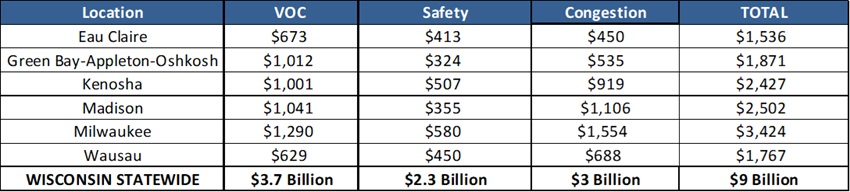
Due to inadequate state and local funding, 42 percent of major locally and state-maintained roads in Wisconsin are in poor or mediocre condition, costing the state’s drivers an additional $3.7 billion each year in extra vehicle operating costs, including accelerated vehicle depreciation, additional repair costs, and increased fuel consumption and tire wear.
From 2024 through 2029, the Wisconsin Department of Transportation (WisDOT) anticipates an average annual funding gap of $313 million between the amount of funding available for maintenance and preservation of state-maintained pavements and the amount needed to keep them in their current condition.
Six percent of Wisconsin’s bridges (920 of 14,428 bridges) are rated in poor condition, meaning there is significant deterioration of the bridge deck, supports or other major components. Forty-eight percent of the state’s bridges are rated in fair condition, and the remaining 46 percent are in good condition. Most bridges are designed to last 50 years before major overhaul or replacement, although many newer bridges are being designed to last 75 years or longer.
Statewide, drivers lose $3 billion annually as a result of lost time and wasted fuel due to traffic congestion. In the most congested area of the state, drivers lose more than $1,500 per year in lost time and wasted fuel and lose 58 hours annually in traffic congestion.
From 2020 to 2025, traffic crashes claimed the lives of 3,542 people in Wisconsin, an average of 590 fatalities each year. From 2020 to 2024, 11 percent of those killed in traffic crashes in Wisconsin were pedestrians or bicyclists. The traffic crash rate per 100 million miles of vehicle travel in Wisconsin is below the national average, at 0.80 compared to 1.10. TRIP estimates that roadway features, while not the primary factor, were likely a contributing factor in approximately one-third of all fatal traffic crashes, resulting in $2.3 billion in economic costs in Wisconsin in 2025. The economic costs of traffic crashes include work and household productivity losses, property damage, medical costs, rehabilitation costs, legal and court costs, congestion costs and emergency services.
As improved fuel efficiency and increased use of electric and hybrid vehicles reduce revenue from Wisconsin’s motor fuel tax—a primary transportation funding source—transportation funding is no longer keeping pace with needs. At the same time, inflation has significantly increased highway construction costs. The Federal Highway Administration’s national highway construction cost index rose 52 percent from early 2022 through the third quarter of 2025, significantly reducing the purchasing power of available transportation dollars.
The reduced buying power of Wisconsin’s state and federal transportation dollars threatens to delay many critically needed highway projects that would improve the safety, reliability and condition of Wisconsin’s most critical highways.
“As a fast-growing state and home to six million, it will be critical that Wisconsin adequately invest in its transportation network in order to provide a system that is smooth, safe and efficient,” said Dave Kearby, TRIP’s executive director. “It is much more cost effective to invest in improving and maintaining the state’s transportation network than to pass along the high costs of a deficient transportation system to drivers”